How to Resize Images for Social Media, Web, and Print
Every digital context has a preferred image size. Social media platforms display images at specific aspect ratios and crop or compress anything that doesn't match. Email clients have maximum width constraints. Print requires specific pixel counts at a given DPI. Getting these dimensions right matters — a correctly sized image displays crisply, fits its container, and doesn't get compressed further by the platform.
Target Dimensions for Major Platforms
Social media dimensions change occasionally, but these are the current standards: Instagram square post: 1080×1080px. Instagram portrait: 1080×1350px. Instagram story: 1080×1920px. Twitter/X post image: 1200×675px. Twitter/X header: 1500×500px. Facebook cover: 820×312px. LinkedIn company banner: 1128×191px. OGP (Open Graph) share image: 1200×630px.
For e-commerce, most platforms display product images at 800×800 to 2000×2000px square. Amazon recommends 2000px on the long edge for zoom functionality. Shopify works best with square images between 2048×2048px and 4472×4472px. Setting exact dimensions in Tracelyx Resize ensures your product images display at full quality without platform-side resizing.
Aspect Ratio Lock and Percentage Scaling
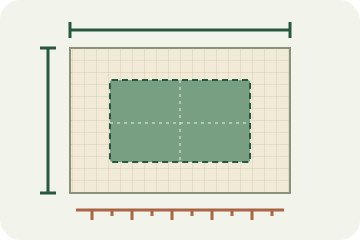
When you change only width or only height with Aspect Ratio Lock enabled, Tracelyx Resize automatically calculates the other dimension to maintain the original proportions. This prevents the stretched or squished appearance that happens when you resize width and height independently. Enable Lock Aspect Ratio before entering your target dimension, then enter just width or height — the tool handles the other value.
Percentage scaling is useful when you want to reduce or enlarge an image by a fixed factor without knowing the exact pixel dimensions. Entering 50% cuts the dimensions in half (and the file size roughly by 75%), while 200% doubles them. This is useful for creating thumbnail versions of images, or for scaling up a reference image before importing it into a design tool.
Resize Without Uploading
Most online image resizers work by uploading your file to a server, resizing it remotely, and letting you download the result. The server retains a copy for the duration of the session — and some services store it longer. For images that are confidential, proprietary, or simply private, this is worth thinking about before using the service.
Tracelyx Resize runs the entire operation in your browser. The file is read into memory locally, resized using the Canvas API, and the output is generated on your device. Nothing is sent to Tracelyx or any third party. This makes it safe to use with unreleased product photos, client images under NDA, and any other image you prefer not to upload.
Start Resizing Your Images
Tracelyx Resize is free, requires no account, and processes your image entirely in your browser. Drop an image, set your target dimensions, and download the result — all in seconds.
Try Tracelyx Resize now →