How to Turn Architecture Photos into Clean Line Drawings
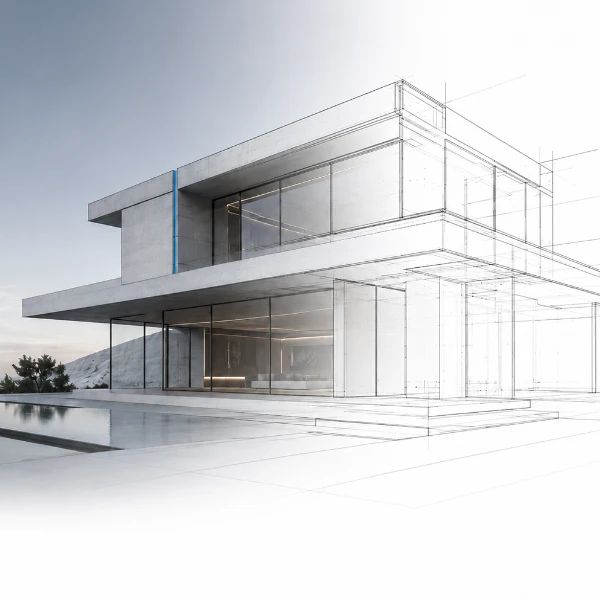
Turning a building photo into a clean line drawing is one of the most useful steps in an architect's or designer's visual workflow. A structural line drawing strips a photograph down to its essential geometry — the outline, the slabs, the columns, the window divisions — and gives you an editable base for presentation boards, perspective underlays, brochures, and CAD or Illustrator work. This guide explains what separates a usable architectural line drawing from a noisy edge filter, how to choose and prepare a source photo, and how to extract and export clean vector lines with ArchitectLine.
What Makes a Good Architectural Line Drawing?
A naive edge-detection filter turns every pixel transition into a line — wall texture, reflections, foliage, paving, and shadows all become marks, and the result reads as a tangle rather than a building. A good architectural line drawing does the opposite: it prioritizes the primary structural edges (the building outline, corners, floor slabs, mullions, and openings) and suppresses the small, incidental detail around them. The result should read clearly as a building, with clean continuous lines that another tool can select and edit.
Equally important is the output format. For professional use, line art is rarely the final image — it is a base asset you scale, recolor, and refine afterward. That means a raster image alone is not enough; you want true vector paths. ArchitectLine is built around this: it outputs black-on-white only, and exports the lines as a vector SVG you can open directly in Illustrator, Inkscape, or CAD.
Choosing and Preparing the Source Photo
The source photo matters more than any setting. Straight-on shots of a facade, or clean three-quarter perspectives with well-defined edges, trace best. Even, flat lighting beats dramatic shadow — hard shadows create false edges that appear as phantom lines. A clear sky or simple background behind the building helps the outline separate cleanly.
Resolution is the other deciding factor. A small image simply does not carry enough edge information for crisp lines, and the result comes out rough and broken. For clean output, aim for at least 1000px on the long edge. If your photo is smaller than that, upscale it first with LinePrep before tracing — ArchitectLine will even show a reminder when it detects a low-resolution image. The difference between a 400px source and the same photo upscaled is dramatic: far more of the building's structure survives into the line drawing.
If the photo includes a lot of surrounding context — neighboring buildings, cars, dense planting — consider cropping to the subject first. Less clutter in the source means fewer stray fragments to clean up later.
Step-by-Step with ArchitectLine
- Upload your building photo — Drag and drop a JPEG, PNG, or WebP, or click to browse. Everything runs locally in your browser; the image never leaves your device.
- Set Edge sensitivity — This controls how many lines are detected. Raise it to capture more structure (fine mullions, distant edges); lower it to keep only the strongest lines.
- Tune Noise reduction — This removes small, isolated fragments — the scattered marks from texture, paving, and foliage around the base of the building — while keeping the connected structure intact. Raise it if the ground area looks cluttered.
- Adjust Smoothing — Higher values simplify the paths into cleaner, straighter lines; lower values preserve fine curvature. For buildings, a moderate amount keeps edges crisp without rounding the corners.
- Set Line weight — Choose the stroke thickness, from hairline to bold, to match how the drawing will be used (a fine line for CAD bases, a heavier line for presentation graphics).
- Export — Download a vector SVG to edit freely in Illustrator or CAD, or a PNG (on a white background) to drop straight into a layout.
Using the SVG in Illustrator and CAD
Because ArchitectLine exports real vector paths, the drawing scales to any size without losing quality. In Adobe Illustrator or Inkscape, open the SVG directly: the lines come in as editable paths you can recolor, change in weight, group, or delete individually. This is where a structural line drawing earns its keep — thicken the building outline, lighten secondary lines, drop a color fill behind the facade, or trace over it for a finished illustration.
For drafting and detailing workflows, the SVG can be brought into CAD as a reference or starting layer, giving you clean geometry to build on rather than a flat photo. And because the output contains the line paths only — no background object — it drops cleanly onto an existing layout or board.
Keeping Your Work Private
Architectural photos often show client sites, competition entries, or unbuilt designs that should not sit on a third-party server. ArchitectLine processes everything inside your browser using the Canvas API. Nothing is uploaded, nothing is stored, and nothing is used to train any model.
When you close the tab, the image and all processing data are gone — there is nothing to retain. For professionals handling confidential project material, that is a real guarantee rather than a marketing line.
Start Making Line Drawings
From a good source photo, ArchitectLine produces a clean, structure-first line drawing in seconds and hands you an editable vector asset ready for presentation, illustration, or CAD. It is free, requires no account, adds no color, and runs entirely in your browser. Drop in a building photo and export an SVG to see how far a single image can go.
Try ArchitectLine now →